
People
by Pastor Mark Downey
Part 1: It is not biblically correct to call non-Whites "people". Explores the word 'people' in the Pentateuch; our founding fathers on 'We the People'; why we're God's chosen people.
Part 2: Proof text showing the racial principles of the New Testament. Only White people can hear the voice of Jesus.
- Read more about People
- Log in to post comments
The Deification of Man
Sermon Notes of Pastor Mark Downey
Scripture Reading: 2 Thessalonians 2:3-4
'The deification of man' is not about one man any more than “the man of lawlessness” is about one man. Anyone who plays God is a “son of destruction” and history is replete with examples. I’m not sure where to start this message, so let’s go to the beginning of Genesis where the thought is whispered to Eve, “Thou shalt be as gods” (Gen. 3:5). Such a deal! Regardless of what you think the tree of knowledge of good and evil was literally, don’t you think Adam and Eve (even if it was for a fleeting moment) thought of themselves as gods? Until, that is, they heard the voice of God say, “Where are you?” (Gen. 3:9). God, likewise, might be asking us the same thing, like “where are your thoughts; where's your head at?” And if we are honest, most of us would say, “O Lord, my mind is not where it should be.” God must have anticipated this problem from the very beginning (being that He knows the beginning from the end) that man would try to deify himself. So much so, that the priority of His Law has always been first and foremost, “Thou shalt not have any other gods before Me” (Ex. 20:3) and “Love the Lord thy God with all thy heart, and with all thy soul, and with all thy mind” (Mt. 22:37). That is virtually impossible to do if you have the mindset to presume that you deserve some kind of deification for yourself, to be worshiped. You may not call it that, but should any one of us take it upon ourselves to judge what is right or wrong, that does not correspond to the Word of God, then that is the embryo of becoming a god.
- Read more about The Deification of Man
- Log in to post comments
The Azure Standard Rebellion
Sermon notes of Pastor Mark Downey
Scripture Reading: Hosea 4:6
How the New Normal is Insanity
The first Christians after Christ died were not jews, who killed Christ and put His blood upon all future generations of Edomite antichrists. The first Christians, so named in Antioch, were the “My people” of Hosea 4:6, and were warned in that verse that they would be destroyed if they fell under the sway of disinformation. They would disqualify themselves from the Melchizedic priesthood. The history of the last 2000 years is a record of the White race ignoring the admonitions of God and His Creation. It is perhaps at its lowest level of knowing what God decrees about race right now. Their mental lapse into situational ethics (which is judaism or secular humanism) would jeopardize the future of God's people. This simple formula for knowing God's will was based on racial exclusion, otherwise known as racism. Today we witness Judah-Germany and all of Europe inviting the rape and pillage of their homelands from racial aliens who devour the land, just as the Bible predicted. It's ridiculous to assume that when God speaks of “My people,” He is specifically referring to every biped on earth, rather than one “peculiar people,” as well as a chosen generation (genetics), a royal priesthood and a holy nation i.e. racially pure (I Peter 2:9). Racial inclusion was never a part of God's plan for the ages. It is fake knowledge that brings God's people into divine rejection. The knowledge of God is our hope for eternal life. When we lose sight of that great promise, God repudiates the prevailing priesthood, which takes our people in a different direction, such as the worship of golden calves to the lust of golden arches. Our God, the God of Israel, hates the vacillation of the priestcraft respecting Baal and conniving social lawlessness. "This is eternal life, that they may know You, the only true God, and Jesus Christ whom You have sent” John 17:3.
- Read more about The Azure Standard Rebellion
- Log in to post comments
Imprecatory Prayer campaign 2017
by Pastor Mark Downey
Part 1: "Christian Identity Imprecation Against Fake News": A call to prayer and fasting from March 23 to May 1, 2017 for the Court of Divine Justice dealing with the Mainstream Media covering up the greatest pedophile ring in history.
Part 2: "Imprecating the Media": Radio Talk Show: William Finck joins Pastor Mark Downey on March 11, 2017 in his call for a 40-day period of imprecatory prayer against the Mainstream Media.
Part 3: "Report on the Imprecatory Campaign": A week by week analysis of our 40 days of prayer and fasting. A briefing of our guests from the Saturday Christogenea podcast of April 29, 2017
- Read more about Imprecatory Prayer campaign 2017
- Log in to post comments
It's the Betrayal, Stupid
Sermon notes of Pastor Mark Downey
Scripure Reading: Luke 21:15-19
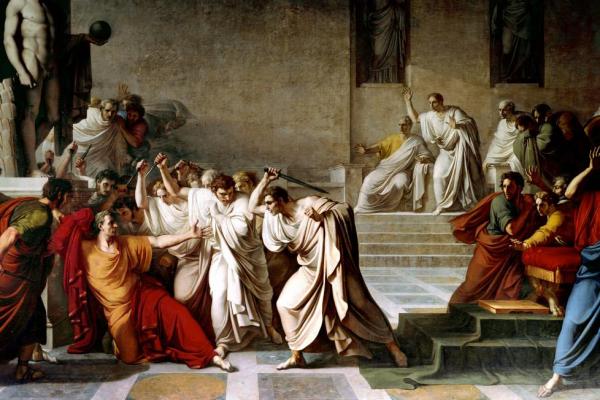 Et tu, Brute?” from Julius Caesar by William Shakespeare. Just seconds before the assassination of the Roman emperor and being stabbed to death, Caesar sees one of the young Senators with knife in hand and exclaims “you also?” Imagine the last words out of your mouth is the surprising question to someone you thought was a loyal friend, but instead your executioner. To live by the sword is to die by the sword has become a common refrain for pacifism, but Jesus' admonition to Peter lobbing off the ear of the high priest's SWAT team member was not anti-sword; it was protecting Peter from being arrested himself, even though Peter was just trying to protect his Master. After Jesus was betrayed by Judas, the cops moved in to make the arrest. In hindsight, Peter should have aimed his sword at Judas, but this was a perfect moment of predestination as Jesus told him, “Am I not to drink the cup that the Father has given me?" John 18:11. The metaphor of a cup often signifies a measure of divine affliction, possibly derived from the custom of some nations putting someone to death with a cup of poison. Jesus had come to die as a sacrifice for sin and betrayal was a necessary ingredient to teach us many lessons which we'll explore today.
- Read more about It's the Betrayal, Stupid
- Log in to post comments
America, the Dialectic
Sermon notes of Pastor Mark Downey
Scripture Reading: James 1:5-8
When you force the combining of good and evil, what do you get? You get the double mind. When you allow non-Whites to have their spaces, their neighborhoods (in which no White person dare walk down the street at night), their own schools and colleges, student unions and race-specific grants and funding, affirmative action just for them in employment, their own racial caucus in Congress, their own TV channel, etc, the modern liberal calls it good. But when any White group wishes to do the same thing, as a matter of culture, identity and benevolence, it's called racist and evil. Welcome to America, the land of dialectical materialism, which early proponents of jewish communism made the centerpiece of their political philosophy. Rabbi Karl Marx asserted that only material things can be reality and thus denying anything spiritual, especially the reality of a White Christian's mind or soul. In his jewish mind, he thought all change happens through the conflict of opposites and is motivated by revolution, thus a forced means to an end, regardless of the spiritual considerations. This can be seen in the social engineering between men and women, children and parents, left wing democrats and right wing republicans, blacks and Whites, Christians and antichrists etc. When you combine good with evil you get the synthesis of chaos. In theory, it is believed that the mechanics of chaos can destroy Christianity.
- Read more about America, the Dialectic
- Log in to post comments
Imprecating the Media
William Finck’s
Christogenea Talkshoe Program
with William Finck and Pastor Mark Downey
Subject: Imprecating the Media
March 11, 2017
William Finck joins Pastor Mark Downey in his call for a 40-day period of imprecatory prayer (which may, of course, be complimented by fasting) against the Mainstream Media. We strive to call attention to the phenomenon of "Fake News". The news has always been fake, to one degree or another, but with the #Pizzagate scandal, the Trump candidacy and now Trump's victory, the fact that at least much of the news is fake is being brought into the public consciousness. We pray that this helps us to bring to our fellow White Americans the fact that the Mainstream Media does publish fake news, when it is not lying by ignoring news-worthy stories, all in order to manipulate public opinion and steer the nation in a manner which fulfills a more nefarious agenda.
Pastor Downey's sermon notes: Christian Identity Imprecation Against Fake News
Follow up reading on pedophilia: Lambs to the Slaughter by William Finck
- Read more about Imprecating the Media
- Log in to post comments
Christian Identity Imprecation Against Fake News
Sermon notes of Pastor Mark Downey
Scripture Reading: Psalms 58:3-11
A call to prayer and fasting from March 23 to May 1, 2017 for the Court of Divine Justice dealing with the Mainstream Media covering up the greatest pedophile ring in history.
Enough is enough. The horrible abuse of power is so far gone that there is no political spine to address the problem of how we receive information. Even with the election of Donald Trump, the Mainstream Media (MSM) is out of control, although it is very much controlled by an insidious group of madmen. Most of Christendom is totally unaware of the Court of Divine Justice, for lack of a better term, whereby we have an appellate jurisdiction when all else fails. When Moses could not adjudicate an impasse of the Law, he had recourse to take it directly to God to reconcile. I could sit back and watch America being raped and plundered, but that's just not me. And I don't think that's the position of many White Christian Americans. But a lot of folks are flustered as to what to do. Yes, prayer is fine and dandy, but we can go one step further in what's called imprecatory prayer, which is a curse upon the enemies of God.
It's Going to Get Worse; It's Going to Get Better
by Pastor Mark Downey
The commonly accepted perceptions of doom and gloom is examined in contrast to Christian principles of hope and blessings. Victory over pessimism and how God's plan for the ages spells defeat for the enemies of Jesus Christ.
Part 1: The commonly accepted perceptions of doom and gloom is examined in contrast to Christian principles of hope and blessings.
Part 2: Optimism's victory over pessimism and how God's plan for the ages spells defeat for the enemies of Jesus Christ.
The Justice in Mercy
by Pastor Mark Downey
The meaning of justice and mercy as it applies to Israel.
Part 1: Mercy is the most important component in the Providence of God and the most misunderstood element of Scripture, because of its racial message to save all of Israel.
Part 2: If salvation is exclusive to Israel, then mercy must follow the same race of people that Christ said hear and follow Him.
- Read more about The Justice in Mercy
- Log in to post comments
A Christian Inaugural Address - 2017
Sermon notes of Pastor Mark Downey
Scripture Reading: Proverbs 29:18 “Where there is no vision, the people perish”
When was the last time you heard another Christian share a vision with you, that wasn’t floating in the ether of raptured prose or pious platitudes, but rather something of a vision that was down to earth, unpretentious, understandable and provides the kind of hope that foments victory? Well, this is a sequel to my sermon ‘Jesus Christ for President,’ because I realized what good is that premise without a follow-up as to how things would be should people rally together in their desire for the government of Christ Himself. Therefore, a vision is a plan with a purpose and a Christian Identity Inaugural address serves the purpose of familiarizing ourselves with what could be our destiny and reality. Unfortunately, our people have been more conditioned and programmed to an apocalyptic end of the world, than an end of the Mystery religions and prophetic Babylon. I think the point of Christ’s return is that the bride has finally made herself ready. And if we could envision an inaugural address, fictional as it may be, where God’s people Israel are on the verge of renewing her vows of marriage, we may not perish after all. I have only given this sermon twice before at the time of George W. Bush being crowned for a second term, during the deification of Obama’s second term (2013) and I give it now (1-8-17) just prior to the Trump era beginning January 20th. Let us now prepare our lives for what must come to pass.
This is an inaugural address that Trump should give, but won't.
- Read more about A Christian Inaugural Address - 2017
- Log in to post comments
The Christmas Meme Must Perish
Sermon notes of Pastor Mark Downey
Scripture Reading: Proverbs 26:23-27
There is nothing worse than people who can't tell the difference between blessings and curses, except for perhaps the shepherd who can't tell the difference. Such a mentality completely nullifies the meaning of Deuteronomy 28. In past sermons I have rebuked Christmas biblically; I have reproved Christmas spiritually; I have chastised Christmas lawfully. I can say unequivocally that I hate Christmas with a perfect hatred; I count it an enemy of Christ and the White race. There are some oxymorons in our movement that would have you believe that if you hate Christmas, you're no different than the talmudic antichrists. This is based on the false premise that Christmas is exclusively Christian. On the contrary, it is inclusive of any savage beast that sports a Santa hat or greets you with the proverbial “Meddy Christmas.“ In Christian Identity we prove that only White people, the true descendants of Jacob-Israel, can be Christians. All other missionary fiascos to non-Israelites are an exercise in futility. Christmas is an open invitation for racial and religious tolerance. Those who promote and perpetuate the unchristian Christmas are missionaries of racial reconciliation. Jews consider Christmas a curse, not because they know there is no blessing in it for the White race, but because judaism is a schizophrenic religion. The jew hates Jesus every day of the year, but if they can sell their cheap trinkets during the holidays, they love to cash in on the goyim. Likewise, Muslim radicals love Christmas as a time of the year to get the most propaganda bang out of their bombs. The talking heads at FOX news have been squealing for the last week that “judeo-Christianity is under attack.” And rightly so: God uses His rod of chastisement against His people when the idols of their heart supplant the Divine Law written in our heart. The only blessing for the true Christian is to boycott the Christmas abomination altogether, as you would any other fraud under the color of Christ.
- Read more about The Christmas Meme Must Perish
- Log in to post comments
The Friction Christian
Sermon notes of Pastor Mark Downey
Scripture Reading: James 4:7 “Submit yourselves therefore to God. Resist the devil, and he will flee from you"
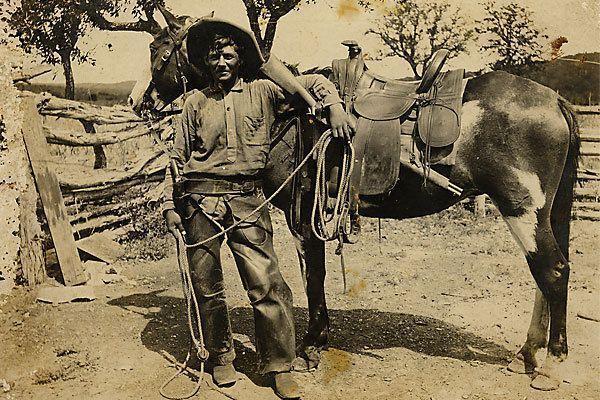 They say a picture is worth a thousand words. So I'm going to talk about this unknown cowboy, who, judging by his saddle, side arm and rifle was riding the trails circa 1870 or 1880. On the back of this early photograph is simply inscribed “Indian fighter.” The more I look at this young man, the more I can see the disappearing manhood from our heritage of the Aryan warrior, the rugged individual or even the Phinehas priest. His boyish look of a young King David should not be confused with youthful indiscretions. To the contrary, I see a determined lad living a fearless life of Joshua, with faith in his bloodline, boldly running through his veins. He was fighting the Canaanites of his day, in a wilderness-turning Promised Land. We don't know if he was a Christian, but there's no denying that the New Covenant/Law was written in his heart and mind as it is with every White person. You can tell by looking at him that he feared no evil, even though he may have walked through the valley of Comanches. My grandpa was a cowboy in Montana and my uncles looked up to him and always admired his true grit, living in a sod house and punching cattle in the waning years of open range in a wild west America. My grandpa's father was a captain in the Confederacy and after the war became a Texas Ranger, whose motto was 'The only good Indian is a dead Indian.” Orwellian historians now deny this expression, being entirely politically incorrect, flushed down the memory hole. In fact, the rewriting of history by Chicano lawyers and academics describe the Rangers in the 1979 book 'Gunpowder Justice' with the utmost calumny and contempt, stating their purpose: “to expose the popular image... to scholarly scrutiny and to analyse the reasons why the Texas Rangers have secured a tenaciously favorable reputation in the minds of the American public.” Let me tell you, the American cowboy is admired throughout the world and made its mark in history and we are exposing the modern Canaanite that would take away our heritage.
- Read more about The Friction Christian
- Log in to post comments
Giving Thanks
by Pastor Mark Downey
There are multitudes (or should I say mixed multitudes) who have benefited from living in the U.S.A., but cannot or will not attribute those benefits to the Benefactor from whence all blessings flow. In this message, I’d like to take a look at the history of gratitude in America; specifically the nature of Thanksgiving Day and how it has evolved. There is something terribly wrong with a White nation that had a Christian beginning, but several hundred years later cannot express the same spirit of thankfulness.
If we are nearing the end of this age, the so called church age, we should also know that the merchants of Babylon will consider the ‘souls of men’ to have the least value of anything, even below the merchandise of horses and chariots and slaves (Rev. 18:13). How did we ever mutate to such a level of decadence and greed and ingratitude?
The Thanksgiving holiday didn’t start in America. It started in ancient times when our race, the men of Israel, were called three times a year to stand before God (Ex.34:23). The feast of Tabernacles was the third and final time for gathering together. It was the most joyous of the three festivals, a time of thanksgiving for all the fruits of the land that had been harvested. Tabernacles reminded Israel of their dwelling in tents in the wilderness, but also pointed to the final harvest when God’s purpose for Israel would be fulfilled and that is the gathering of all the holy nations of a peculiar people, a chosen generation, a royal priesthood gathered unto the Lord.
- Read more about Giving Thanks
- Log in to post comments
Jesus Christ for President
by Pastor Mark Downey
November 13, 2016
Scripture Reading: Isaiah 9:6-7
I have given this sermon 5 times and each time I have changed the names of the guilty, a protected class, in the hope of cutting the strings between the puppets and the puppet masters. The only person that will make us stronger together and make America great again is Jesus, our Messiah. Once again, Republicrats have put on a good show. In fact, I've said for years that there should be a special division at the Academy Awards for politicians. In 2016, we have been subjected to the illusion that the election wasn't supposed to happen the way it did, contrary to Franklin Roosevelt saying, “In politics, nothing happens by accident. If it happens, you can bet it was planned that way.” One thing is certain: a gullible and impressionable public thinks there's been a regime change. They are wrong. The jew is still racketeering according to the Protocols. Already, Trump is saying Obama is “a very good man.” I guess, the Donald never got my memo. I hope this is the last time I have to give this sermon. Jesus, come quickly.
In 1993 I brainstormed and engineered this idea of ‘Jesus Christ for President’ for the 1996 presidential election (between Clinton and Dole) in the now defunct Populist Party. Every 4 years I bring up this interesting proposal with less and less interest from those who hear it. I don't think there's ever been so much bitter rancor. America has been bankrupt for presidential leadership, the top position in the executive branch of government for decades. This year’s election, in the year of our Lord 2016, is being touted as the most important one ever. Actually, I've heard that one before. However, a contest between a witch and a wizard is no contest at all for White Christian Americans. It’s the proverbial ‘lesser of two evils’ and we do not consent to be governed by evil. Voting for the Hillary or the Donald would be giving our consent to the antichrists. So please allow me to give you an overhauled history and analysis of what happened since 1993 to the present, followed by the positive joys of tribulation and our appointment with destiny.
- Read more about Jesus Christ for President
- Log in to post comments
Talking Politics to Death
William Finck’s
Christogenea Internet Radio
with William Finck and Pastor Mark Downey
Subject: Talking Politics to Death
Pastor Mark Downey joined William Finck of Christogenea.org in October 2016 for an online discussion regarding the 2016 Presidential election.
- Read more about Talking Politics to Death
- Log in to post comments
The United States of Amorality
Sermon notes of Pastor Mark Downey
October 23, 2016
Scripture Reading: Daniel 8:23-25
The conjunction of witchcraft/Halloween with an election year, manipulated by a pornographic news media is the fruitful absence of a nation void of moral standards.
For those listening and not reading, amorality is one word, not two. If we were a moral nation, things would be much different. The word amorality means indifferent to or incapable of distinguishing between right and wrong; having no moral standards, restraints, or principles. One dictionary went so far as to say, “Humans... are amoral and what guides them is not any sense of morality but an instinct for survival.” Of course, we disagree with placing ourselves on the level of mere animals. We are the children of God and He gives us the means to flourish as no animal can do. We are the only race, by intelligent design, to experience the transformation of amoral to moral, from a carnal nature to a spiritual supremacist. I don't have that many more election sermons to do for 2016 as the fuse is burning quickly. I sent three copies of my open letter (in the second week of October) to the Trump Towers in Jew York City and we shall see if they shall stand or fall like the twin towers. The modern tower of Babel is reaching unto heaven, but there will never be enough steps to get there. In fact, the steps are going in the opposite direction, in which the foreseeable future is heaven's antithesis. It's appalling, that as we move closer to Election Day, the fabric of our society is interwoven with the religion of Halloween and the obsessive-compulsive hysteria of mainstream media whores rubbing America's nose in the pornographic smut of Jerry Springer politics. Our only hope is being transformed by the renewing of our racial consciousness.
- Read more about The United States of Amorality
- Log in to post comments
Open Letter to Donald Trump
Donald Trump
Chairman, President and CEO
c/o The Trump Organization
725 Fifth Avenue
New York, NY 10022
Dear Mr. Trump,
I don't know where to begin, but I need to get your immediate attention. I've noticed there are innumerable “open letters” to you and for the most part they are all hostile and grubbing for their own special interest. This is not a hostile letter, but sent in the love of Jesus Christ. You have announced to the world that you are a Christian and that really doesn't need to be equivocated by denomination. I write to you as a pastor, politically incorrect patriot and presidential advisor in the tradition of colonial election sermons. My interest is the same as yours: to make America great again. This letter may be the most important thing you ever read in your lifetime, if it can pass through the filters of campaign intercessors and reach your eyes only. Actually, if it touches your heart to love the truth of God more than anything else, my one and only goal will be fulfilled.
- Read more about Open Letter to Donald Trump
- Log in to post comments
Make America Hate Again
Sermon notes of Pastor Mark Downey
Scripture Reading: Proverbs 8:13 - “The fear of the Lord is to hate evil: pride, and arrogance, and the evil way, and the fraudulent mouth, do I hate.”
You might agree with today's message and that would be alright. It's about time. Coming to the truth is sometimes on borrowed time after a lifetime of lies and that's called grace. It's coming to an understanding of unmerited favor. But, better late than never. God created time and there is “A time to love, and a time to hate” Eccl. 3:8. You either believe that as a Christian or you might as well be an atheist. Love without hate or vice versa is a nullification of the Gospels of Jesus Christ. America used to hate what most people today love. This is somewhat of an election sermon leading up to my open letter to Donald Trump (if he doesn't get killed). I must give credit where credit is due for today’s sermon title. Thank you Hillary Clinton for your hatred of us Americans who you consider “deplorable.” It's not just Trump supporters, but anyone who does not genuflect to the libertard agenda of anti-White and pro-global elitists is a stunning witness to mind control run amuck. For so much noose-worthy current events of a Jezebel anti-type (a New Testament parallel to the Old) having so much enigmatic health concerns, her mouth seems to be functioning like a high performance Denny Crane (that's a jewish lawyer with a messianic complex). Not only are those not voting for Hillary a basket of deplorables, which had to be a premeditated jingoism, but the same comedy writers side-swiped us with the jingo 'make America hate again.'
- Read more about Make America Hate Again
- Log in to post comments
Christian Identity - What Is It?
 "For thou art an holy people unto the Lord thy God: the Lord thy God hath chosen thee to be a special people unto himself, above all people that are upon the face of the earth."Deuteronomy 7:6
As the word identity implies, it is the condition of being the same as something described or asserted. Christian Identity establishes who the true Israel is today according to the Holy Bible and world history. There is more than adequate and convincing proof that the Anglo-Saxon, Celtic, Scandinavian, Germanic and kindred peoples are the racial descendents of the tribes of Israel.
Kinsman Redeemer Booklets
Kinsman Redeemer Ministries newsletter
Monthly archive
- March 2026 (1)
- January 2026 (1)
- December 2024 (9)
- November 2024 (3)
- September 2024 (1)
- October 2021 (1)
- January 2020 (4)
- April 2018 (1)
- February 2018 (2)
- January 2018 (1)